
other · Articles
Chargers, Cables and Hubs
Chargers, Cables and Hubs
 Transact Shopping
TECH · GLOBAL
Chargers, Cables and Hubs
USB-C and power delivery, cable ratings, hubs and safety
USB-C looks like one standard and behaves like several, which is why two identical-looking cables perform very differently.
Power delivery
A charger's wattage and the device's requirement have to meet. A 65 watt charger runs most laptops; a phone needs far less. Power delivery negotiates the right voltage, so a higher-wattage charger does not damage a small device.
GaN chargers are smaller and cooler for the same output, which is why they have largely replaced older designs.
Cables are not interchangeable
Charge-only cables carry no meaningful data. High-power charging above 60 watts requires an e-marked cable rated for 5 amps. Data speed is a separate specification again, from USB 2.0 speeds up to Thunderbolt.
A cheap cable in a laptop-charging role is where overheating happens. Buy cables that state their wattage and data rating.
Hubs and docks
A bus-powered hub shares the laptop's power and suits keyboards and drives. A powered dock has its own supply and runs monitors and charges the laptop over one cable.
Check the display support carefully — the number of screens and refresh rates depend on the laptop as much as the dock.
Safety
Buy chargers with a recognised safety mark from established brands. Counterfeit chargers are a genuine fire and shock risk and are widespread on marketplaces.
Charge on a hard surface where you are present, never under bedding, and stop using anything that gets unusually hot.
Cable management
Support the weight rather than hanging it off a connector, which is where cables fail. Route with a little slack at each end and avoid tight bends at the plug.
Label chargers and cables, since identical black bricks are impossible to tell apart.
Disposal
Cables and chargers go to electrical recycling rather than household waste, and many contain recoverable copper.
Batteries and power banks
Check the capacity in milliamp hours and the output wattage, since a large battery with slow output charges a laptop poorly. Airlines limit the capacity that may be carried, and power banks must be in hand luggage.
Stop using any pack that swells, gets unusually hot or smells, and never carry a damaged one.
Buying
Established brands with a stated safety certification. A charger is not the place to save two pounds.
Working out what you need
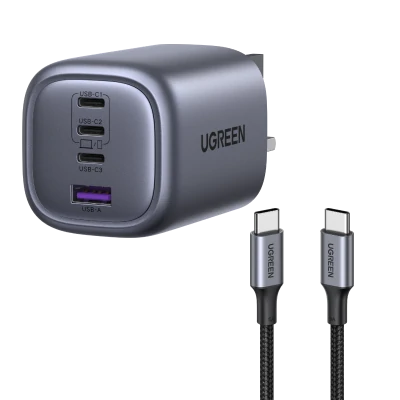
Count the devices you charge at once and add their wattages, then buy one charger rather than several. A single multi-port charger replaces a tangle of bricks.
Check the port type, since some ports on a multi-port charger are far slower than others.
Travel
One multi-port charger replaces several bricks. Check plug type and that it handles the local voltage.
WHERE TO BUY
Ready to shop UGREEN? Use the link below to visit the official store.
→ Shop UGREEN — official site
Visit this site