
other · Articles
Buying Tyres: What the Markings Mean
Buying Tyres: What the Markings Mean
 Transact Shopping
AUTOMOTIVE · UNITED KINGDOM
Buying Tyres: What the Markings Mean
Reading a sidewall, load and speed ratings, the EU label and when to replace
Tyres are the only part of a car touching the road, and the markings on the sidewall tell you exactly what you need to buy.
Reading the sidewall
A marking such as 205/55 R16 91V gives the width in millimetres, the aspect ratio as a percentage of width, the construction, the rim diameter in inches, then the load index and the speed rating.
The load index and speed rating must meet or exceed what your vehicle requires. Fitting a lower rating is unsafe and can invalidate insurance.
The label
Tyres sold in the UK and EU carry a label rating fuel efficiency, wet grip and noise. Wet grip is the one with the clearest safety implication, and the difference between grades is measurable in braking distance.
Age matters as well as tread
The four-digit DOT code gives the week and year of manufacture. Rubber degrades with age regardless of use, and many manufacturers advise replacing tyres over about ten years old even with plenty of tread.
Check the date code when buying, since tyres can sit in storage for years.
When to replace
The legal minimum in the UK is 1.6mm across the central three quarters, and braking performance in the wet falls off well before that. Many organisations recommend replacing at 3mm.
Replace immediately for sidewall bulges, cuts, exposed cords or uneven wear, which suggests alignment or pressure problems.
Fitting
Replace in pairs across an axle, with the better pair on the rear, since rear grip loss is harder to control. Do not mix tyre types across an axle.
Seasonal tyres
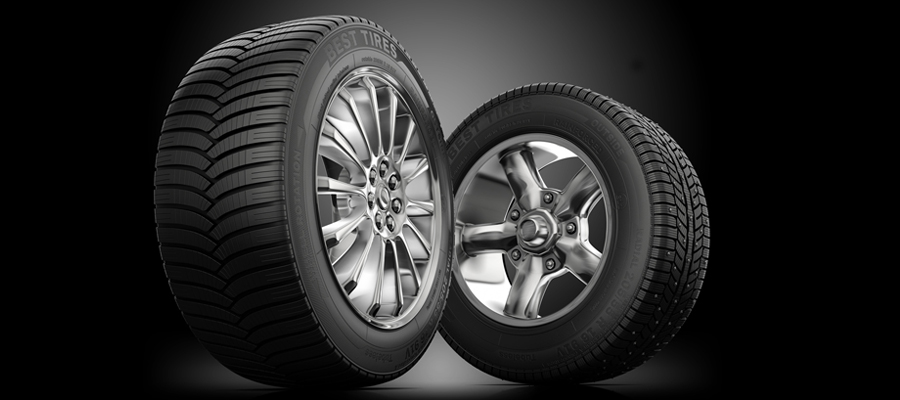
Winter tyres use a different rubber compound that stays flexible below about seven degrees, which improves grip considerably in cold weather rather than only in snow. All-season tyres compromise between the two.
Several European countries require winter tyres or equivalent at certain times of year, so check before driving abroad.
Fitting and disposal
Have wheels balanced when tyres are fitted, and re-torque wheel nuts after the first fifty miles. Old tyres must go to a licensed disposal route.
Run-flats and repairs
Run-flat tyres allow limited driving after a puncture and are generally not repairable, which makes them expensive to replace. Check what your car came with before assuming a repair is possible.
Punctures in the central tread area within limits can usually be repaired to standard; sidewall damage never can.
Pressure
Check monthly when cold against the figure on the door frame, not the tyre. Under-inflation lengthens braking distances and causes blowouts.
Have the alignment checked after hitting a kerb or a deep pothole.
WHERE TO BUY
Ready to shop Tyres UK? Use the link below to visit the official store.
→ Shop Tyres UK — official site
Visit this site