
sports · Articles
Riding Hats, Body Protectors and Safety Kit
Riding Hats, Body Protectors and Safety Kit
 Transact Shopping
SPORT · GLOBAL
Riding Hats, Body Protectors and Safety Kit
Current standards, fitting, when to replace and the rest of the kit
Riding equipment is governed by standards that have changed in recent years, and the item that matters most is the one people keep for too long.
Hat standards
Check the hat meets a current standard accepted by your discipline's governing body, since older standards have been withdrawn and some are no longer permitted in competition.
Many bodies require hats to be tagged after a check by a trained fitter. Riding schools and competitions will turn away a hat that is not to an accepted standard.
Fitting
Have it fitted properly by someone trained, since head shapes differ and a hat that rocks or presses is doing less than it should. It should sit level, about two finger widths above the eyebrows, with no movement when you shake your head.
The harness should be firm with one finger's space under the strap.
Replace after any fall
The liner crushes once to absorb energy and does not recover, even with no visible damage. Replace it after any fall in which the hat hit the ground, and generally every three to five years regardless.
Never buy a used hat, since the impact history is exactly what matters and is invisible.
Body protectors
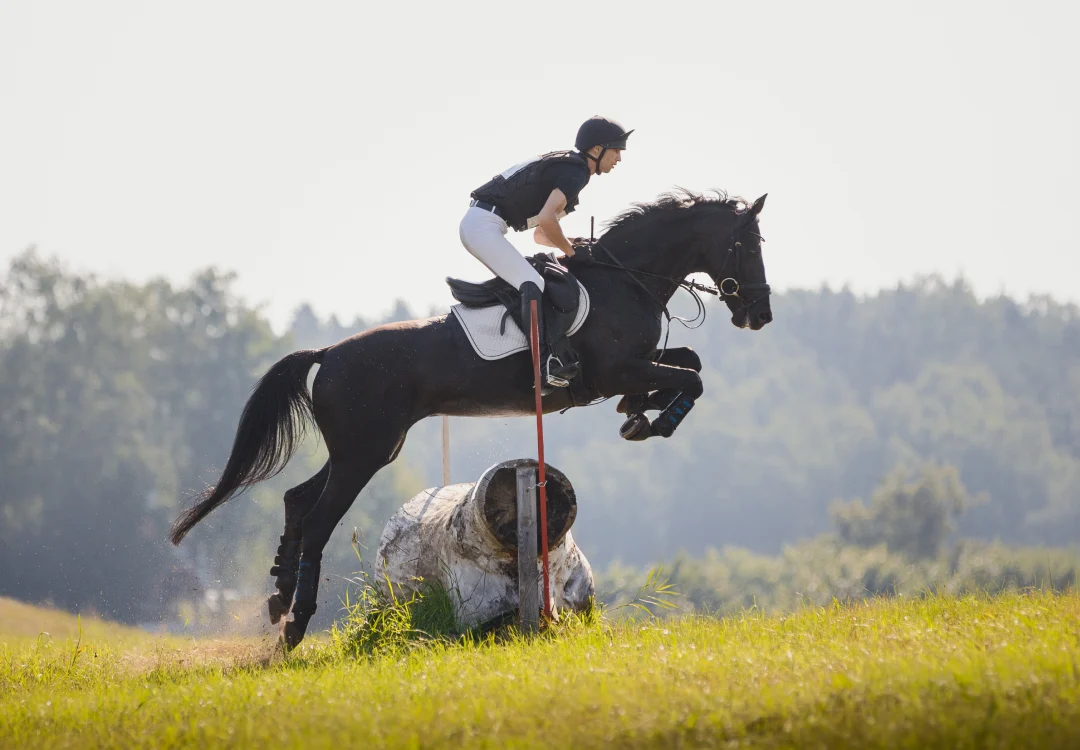
Look for the current standard and the appropriate level for your activity — cross country requires the highest. Fit is critical: it must cover the lower back without restricting movement in the saddle.
Air jackets are worn over a body protector rather than instead of one, and the canister must be armed and serviced.
Footwear and gloves
Boots with a small heel and a smooth sole so the foot cannot slide through the stirrup. Gloves for grip, and no loose scarves or jewellery.
Clothing and comfort
Breeches with the correct grip for your discipline, layers rather than a single thick coat, and gloves that fit closely. Cold hands lose feel on the reins, which matters more than comfort.
Keep hair tied and tucked, and avoid anything loose that could catch.
Tack and fit
A badly fitting saddle causes pain, behaviour problems and long-term damage, and horses change shape through the year. Have saddles checked by a qualified fitter at least annually.
Check girths, stirrup leathers and bridle stitching regularly, since these fail under load.
Riding on roads
High-visibility for horse and rider, ride with traffic, and thank considerate drivers. Report dangerous incidents, since that is what informs road safety work.
Yard safety
Sturdy boots with toe protection around horses, gloves for leading and lungeing, and hair tied back. Tetanus vaccination should be up to date for anyone working with horses and soil.
Tell someone when you are riding out alone and carry a phone.
Visibility
High-visibility for horse and rider on roads, and lights in poor light.
WHERE TO BUY
Ready to shop GS Equestrian? Use the link below to visit the official store.
→ Shop GS Equestrian — official site
Visit this site