
home · Articles
Wet and Dry Vacuums
Wet and Dry Vacuums
 Transact Shopping
HOME · GLOBAL
Wet and Dry Vacuums
What they are for, filters and bags, safety with liquids and maintenance
A wet and dry vacuum handles jobs a household machine cannot, and using one incorrectly is both messy and genuinely dangerous.
What they suit
Workshop debris, plaster dust, wet spills, blocked sinks, car interiors, fireplace ash once completely cold, and flood clean-up. They are built for volume and coarse material rather than fine carpet cleaning.
They will not replace a domestic vacuum for carpets, since most have no motorised brush bar.
Switch the filter for wet pickup
Every machine has a different arrangement, and most require removing the paper or cartridge filter before sucking liquid. A soaked paper filter blocks instantly and can damage the motor.
Remove any dust bag too, and check the manual rather than assuming.
Fine dust needs the right filter
Plaster and concrete dust passes straight through a standard filter and out of the exhaust, which fills a room. Use a fine dust filter or a bag rated for it, and wear a mask rated for the dust.
Silica dust from concrete, brick and tile cutting is a serious respiratory hazard and needs an M or H class extractor rather than a general wet and dry.
Safety with liquids
Never pick up flammable liquids, solvents, petrol or hot ash. Never use one to clear water where there is any electrical hazard, and plug into a socket protected by an RCD.
Empty the tank before it is full, since an overfull tank can spill back.
Maintenance
Empty and rinse the tank after wet use and let it dry completely with the lid off, since a sealed damp drum smells within days. Clean or replace filters regularly.
Clearing a blocked sink
A wet vacuum pulls a blockage back towards you rather than pushing it further in, which works where a plunger fails. Seal around the plughole and give it short bursts.
Never combine this with drain chemicals already poured down, since you would be sucking up caustic liquid.
Car interiors
A crevice tool and a narrow nozzle do most of the work. Move seats fully forward and back, and vacuum the seat rails, where an extraordinary amount collects.
Choosing one
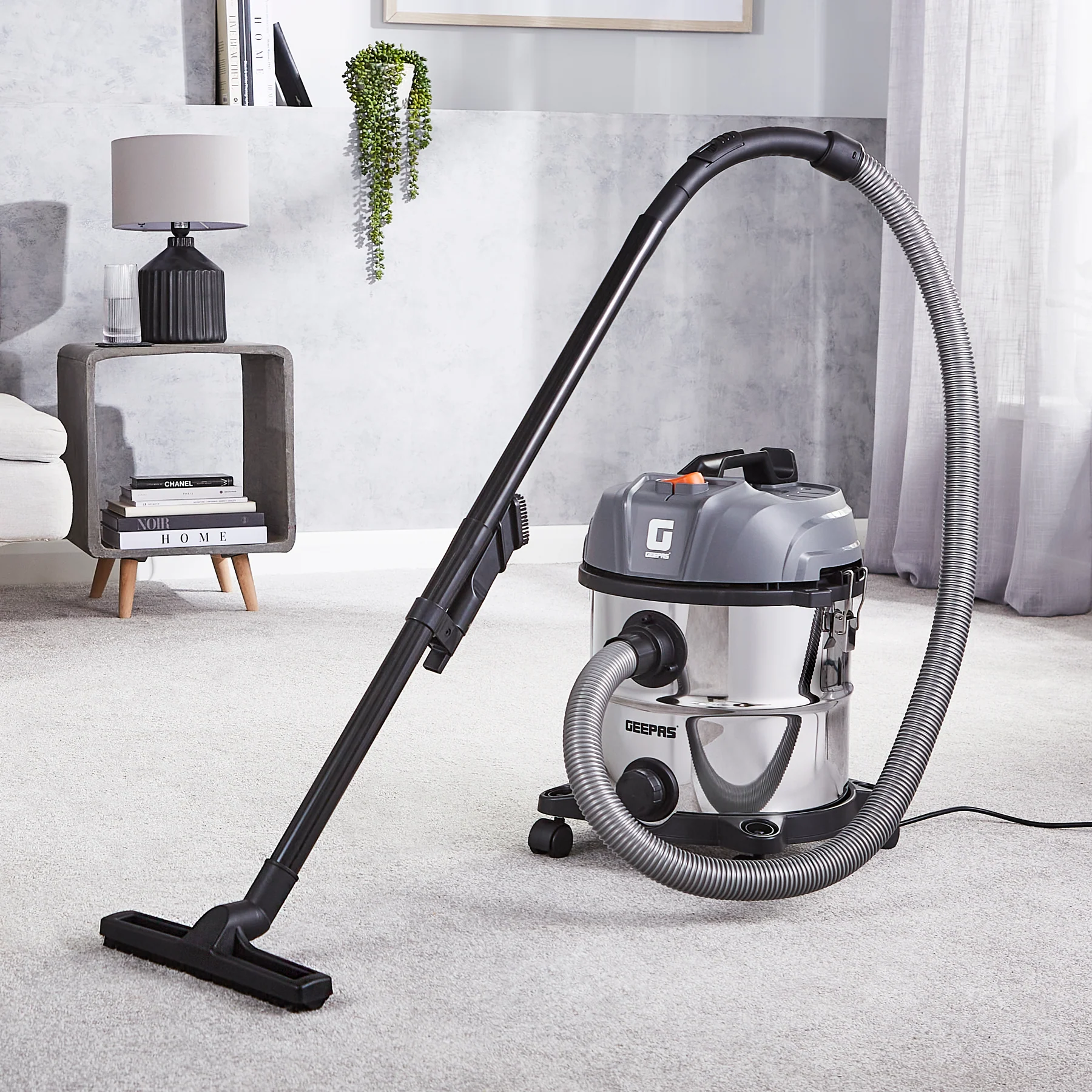
Compare the tank capacity, the airflow rather than the wattage, the hose diameter and the cable length. A larger drum means emptying less often and a heavier machine to move.
Check whether accessories are a standard 32 or 35 millimetre fitting, since that determines what you can attach later.
Check the noise rating, since these are considerably louder than a household vacuum.
Buying
Compare the tank capacity, the airflow rather than the wattage, hose diameter and whether accessories are a standard size.
WHERE TO BUY
Ready to shop Geepas? Use the link below to visit the official store.
→ Shop Geepas — official site
Visit this site