
other · Articles
Reading Glasses: What They Do and What They Do Not
Reading Glasses: What They Do and What They Do Not
 Transact Shopping
HEALTH · GLOBAL
Reading Glasses: What They Do and What They Do Not
Presbyopia explained, choosing a strength, why eye tests still matter and progressive lenses
Ready-made reading glasses are convenient and inexpensive, and they solve one specific problem while leaving several others unaddressed.
What is happening
Presbyopia is the gradual stiffening of the lens inside the eye, which reduces the ability to focus close up. It affects essentially everyone from around the mid-forties and is a normal part of ageing.
Reading glasses add magnification to compensate. They do not slow the process down, and using them does not make eyes lazy.
Choosing a strength
Ready readers are sold in dioptres, commonly from \+1.00 to \+3.50. Start at the lowest strength that lets you read comfortably at your usual distance, and expect to move up every few years.
The same strength in both eyes is the limitation. Most people's eyes differ, and ready readers cannot correct astigmatism or a difference between eyes.
They are not a substitute for an eye test
An eye examination checks for glaucoma, cataracts, macular degeneration and diabetic changes, several of which cause no symptoms until damage is done. It also picks up general health conditions.
Adults should be tested at least every two years, and more often on advice. Tests are free for several groups in the UK.
When to see an optician rather than buy readers
Headaches, eye strain, one eye noticeably worse, double vision, or a sudden change in vision. Sudden vision loss, flashes or a shower of floaters needs urgent attention.
Progressive and varifocal lenses
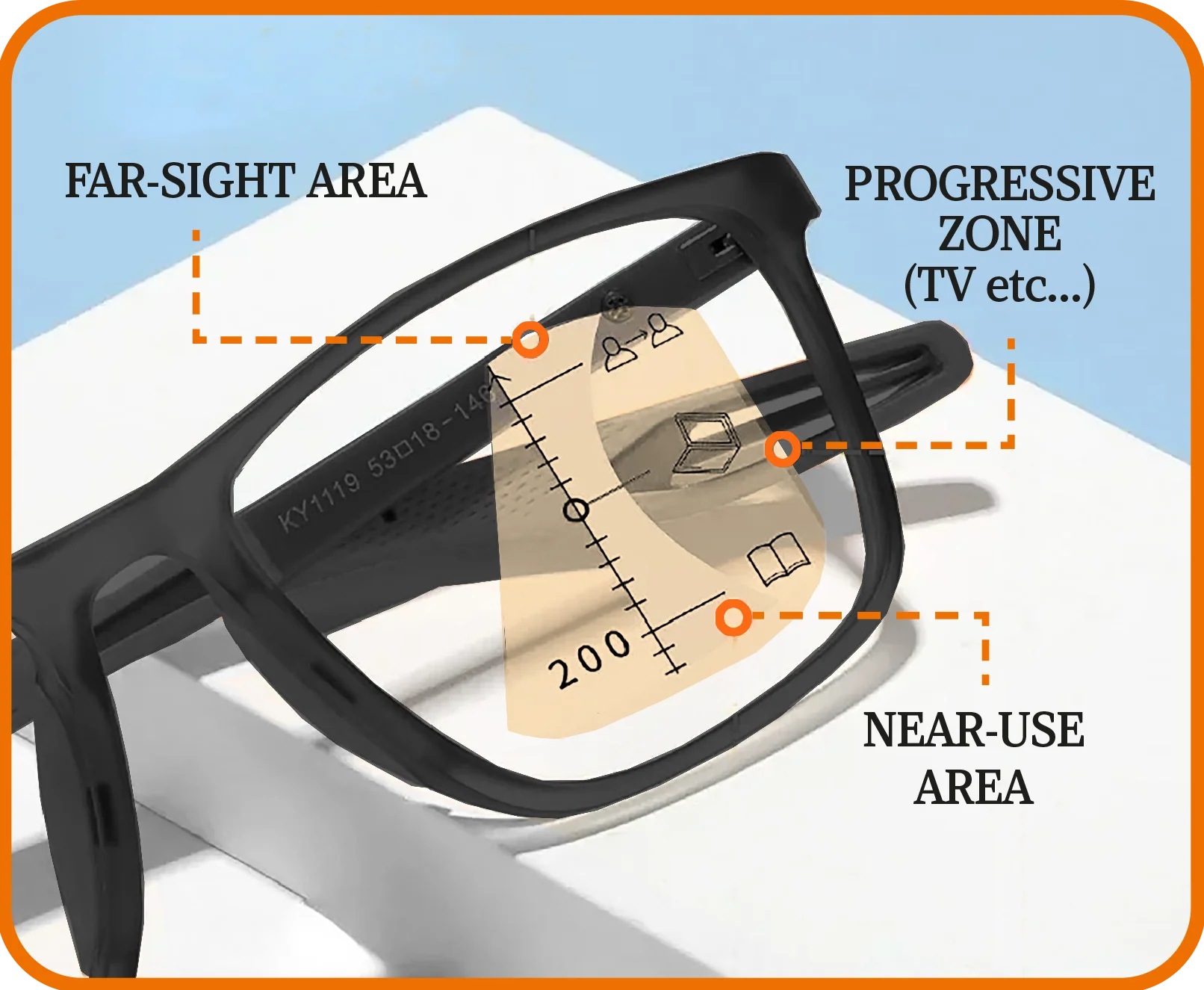
These handle distance, intermediate and near in one lens and need proper fitting and a period of adjustment. They suit anyone who also needs distance correction.
Looking after your eyes
Take regular breaks from close work — looking at something at least six metres away for around twenty seconds, every twenty minutes or so, reduces eye strain measurably.
Good task lighting, a screen at arm's length and slightly below eye level, and sunglasses with genuine ultraviolet protection outdoors all help considerably.
Spare pairs
Keep a pair wherever you actually read — beside the bed, in the kitchen, in a bag or in the car. Most people end up buying two or three cheap pairs rather than hunting for a single one.
Free and reduced-cost tests
Eye tests are free in the UK for children, over-sixties, people with diabetes or glaucoma, and several other groups. Vouchers towards glasses are available for some groups, and many employers are required to fund tests for screen users.
These are widely underclaimed, so it is worth asking about them rather than assuming you do not qualify.
Practical
Keep a pair where you actually read, and check the lens quality rather than judging a pair only on its price.
WHERE TO BUY
Ready to shop Five Star Direct? Use the link below to visit the official store.
→ Shop Five Star Direct — official site
Visit this site