
health · Articles
Nootropic Drinks: What Is Actually in Them
Nootropic Drinks: What Is Actually in Them
 Transact Shopping
HEALTH · GLOBAL
Nootropic Drinks: What Is Actually in Them
The ingredients with evidence, the ones without, caffeine totals and safety
Drinks marketed for focus combine a list of ingredients, and the number with meaningful human evidence is small. Reading the panel tells you most of what you need.
Caffeine does most of the work
Caffeine has strong evidence for alertness, reaction time and perceived effort, and it is almost always the active ingredient producing the effect people notice.
Check the milligrams per serving on the label. A typical cup of coffee holds around 80 to 100, and some of these drinks hold considerably more than that.
L-theanine
Found in tea, and the combination of caffeine with L-theanine has reasonable evidence for attention with less jitteriness than caffeine alone. Studied doses are commonly around 100 to 200 milligrams alongside caffeine.
This is the best-supported pairing in the category.
Where evidence is weaker
Many herbal and amino acid ingredients appear at doses well below those used in research, or have only preliminary studies behind them. Alpha-GPC, bacopa and lion's mane all have some research and none of it is conclusive.
A proprietary blend listing ingredients without individual quantities cannot be evaluated at all, and is the standard way to disguise token amounts.
Add up your total caffeine
Most adult guidance sits around 400 milligrams a day. Counting coffee, tea, energy drinks and these products together is the only way to know where you are.
Caffeine has a half-life of around five hours, so an afternoon drink affects sleep that night, which then worsens the concentration you were trying to fix.
Who should be careful
Anyone pregnant or breastfeeding, with a heart condition, high blood pressure or an anxiety disorder, or taking medication that interacts with stimulants. Not for children.
Reading the panel
Check the amount of each ingredient per serving against the dose actually used in research, and note how many servings are in a can. A blend listed without individual quantities cannot be assessed.
Look for independent third-party batch testing, particularly if you are subject to drug testing in sport or at work.
Cost
Work out the cost per day and compare that against a good coffee and a decent night's sleep. For most people the arithmetic favours the second.
What the research actually supports
Caffeine and the caffeine-theanine pairing are the two claims in this category with reasonable human evidence behind them. Everything else is somewhere between preliminary and unsupported.
Judge a product on whether it delivers a researched dose of those rather than on the length of the ingredient list on the can.
The unglamorous basics
Sleep, exercise, hydration and removing your phone from the room have considerably more effect on concentration than anything in a can.
WHERE TO BUY
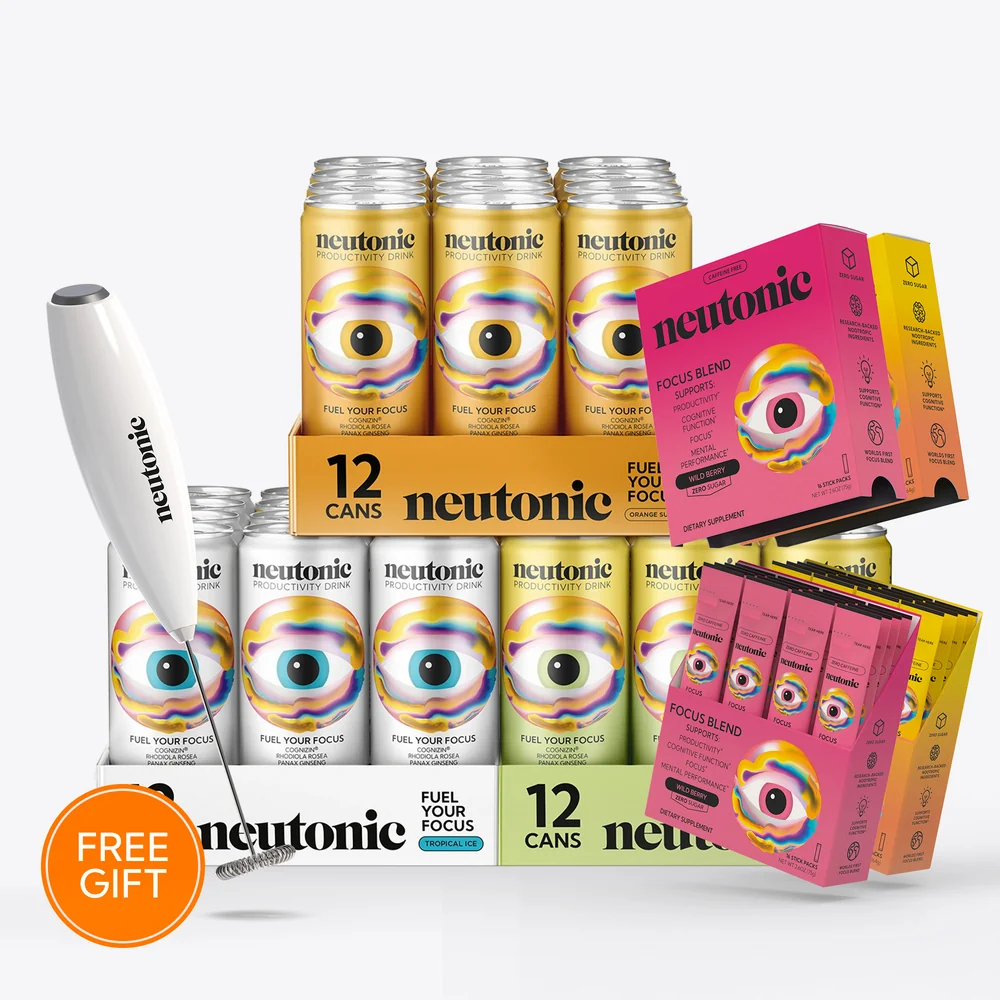
Ready to shop Neutonic? Use the link below to visit the official store.
→ Shop Neutonic — official site
Visit this site