
garden · Articles
Artificial Plants: When They Are the Right Answer
Artificial Plants: When They Are the Right Answer
 Transact Shopping
HOME · UNITED STATES
Artificial Plants: When They Are the Right Answer
UV stability, fire ratings and how to make faux greenery look convincing
Artificial plants carry a reputation problem earned largely by products from twenty years ago. Modern manufacturing has closed much of the gap, and there are specific situations where faux is not a compromise but simply the correct choice.
Where real plants genuinely cannot work
North-facing rooms with minimal natural light. Windowless offices and hallways. Rental properties where you may move at short notice. Homes with pets or small children where many popular houseplants are toxic. And anywhere nobody will reliably water anything.
In these situations the honest comparison is not faux versus real. It is faux versus nothing, or faux versus a succession of dead plants.
Outdoor use needs UV stability
This is the specification that matters most and is most often overlooked. Standard artificial foliage fades badly in direct sunlight, sometimes within a single season, turning an unconvincing shade of pale blue-green.
UV-stabilised products are manufactured with additives that resist this. If a product is intended for a balcony, garden or conservatory, confirm UV stability explicitly rather than assuming outdoor suitability.
Fire ratings for commercial spaces
Some commercial spaces may require fire-retardant certification for artificial foliage. Check local rules for your setting and request product documentation where a rating is required. For domestic use it is optional but not a bad idea near heat sources.
Making it look convincing
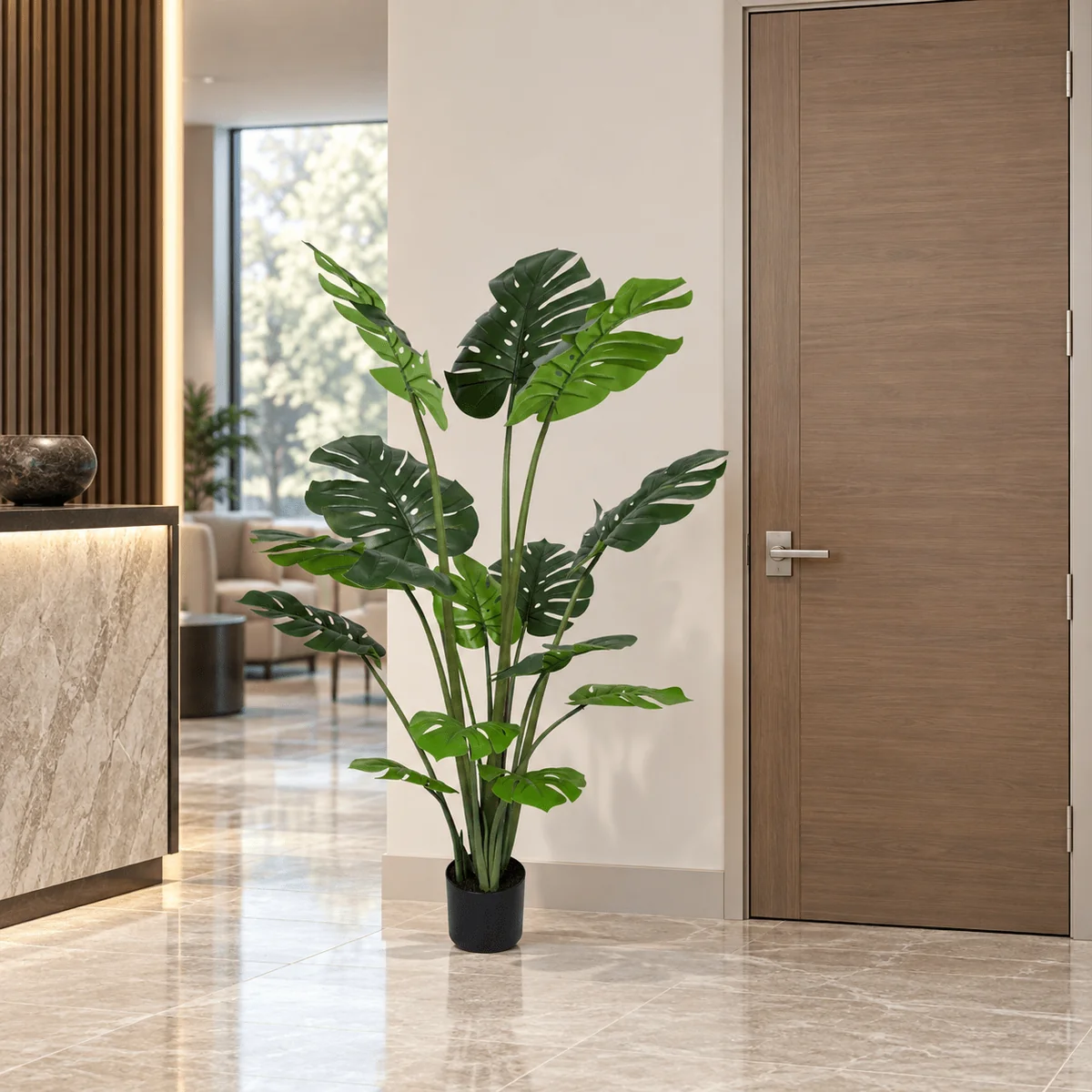
Variation is the whole trick. Real foliage is irregular — different leaf sizes, imperfect colour, asymmetric growth. Identical repeated units read as fake immediately, so mix species and sizes rather than installing a uniform block.
Bend and shape the stems after unpacking. Everything arrives compressed from shipping, and five minutes spent opening out the foliage makes a substantial difference. Put a real plant nearby if you have one; the contrast helps rather than hurting.
Scale and placement
Undersized foliage is the most common installation mistake. Greenery reads as decoration when it is too small and as architecture when it is the right scale, and the right scale is usually larger than people expect for the space.
Place artificial plants where they make sense botanically. A sun-loving species in a windowless corner is noticed subconsciously even by people who cannot say why something looks wrong.
Pots matter as much as the plant
A good ceramic or concrete pot does more for realism than an upgrade to the foliage itself. Adding a layer of real soil, moss or gravel on top of the base conceals the mechanism and is the cheapest possible improvement.
Maintenance
Dust is the only enemy. Wipe leaves every few weeks or use a low-pressure air blower for dense arrangements. Dusty artificial foliage looks obviously fake in a way that clean foliage does not, and this is the main reason installations stop looking convincing over time.
WHERE TO BUY
Ready to shop Designer Plants? Use the link below to visit the official store.
→ Shop Designer Plants — official site
Visit this site