
health · Articles
Blood Glucose Monitoring at Home
Blood Glucose Monitoring at Home
 Transact Shopping
HEALTH · GLOBAL
Blood Glucose Monitoring at Home
How meters work, accuracy standards, testing technique and interpreting results
Home glucose monitoring is central to managing diabetes, and the results are only as good as the technique and the equipment. This is general information and does not replace advice from your diabetes team.
Speak to your clinician first
How often to test, what your targets are, and what to do with the numbers depend entirely on your type of diabetes and your treatment. Those are clinical decisions rather than general ones.
Anyone on insulin or on medication that can cause hypoglycaemia has different requirements from someone managing with diet alone.
Accuracy standards
Meters sold for medical use should meet the ISO 15197 standard, which defines how close readings must be to a laboratory measurement. Check the meter states compliance.
Even a compliant meter has a permitted margin, so a single reading is a guide rather than an exact figure.
Technique changes the number
Wash and dry hands before testing. Traces of fruit, juice or sugar on a finger produce dramatically high readings, which is one of the most common causes of a confusing result.
Use the sides of the fingertip rather than the pad, which has more nerve endings, and alternate fingers. Use a fresh lancet each time.
Strips and storage
Strips are meter-specific and cannot be substituted. Check the expiry date, keep the vial closed, and note that heat, cold and humidity all affect them.
Code the meter if it requires it, since an uncoded meter gives wrong results.
Continuous monitors
Sensors worn on the skin give a continuous picture and read interstitial fluid rather than blood, so they lag behind a finger-prick reading during rapid changes.
Other things a meter cannot tell you
Long-term control is assessed with an HbA1c blood test, which reflects average glucose over roughly three months. Home readings and HbA1c answer different questions.
Keep a record of readings with the time and what you had eaten, since the pattern is more informative than any single number.
Sharps and disposal
Lancets and needles go into a sharps container, never into household waste. Ask your pharmacy or health service how to obtain and return one.
Travelling with supplies
Carry meters, strips and medication in hand luggage rather than the hold, where temperatures and pressure affect them. Take more than you need and a letter from your clinician if you carry needles.
Time zone changes affect medication timing, so plan that with your diabetes team before travelling.
When to seek help
Very high or very low readings, symptoms that do not match the number, or repeated unexplained results need medical advice rather than another test.
Know how to recognise and treat hypoglycaemia, and make sure someone around you does too.
WHERE TO BUY
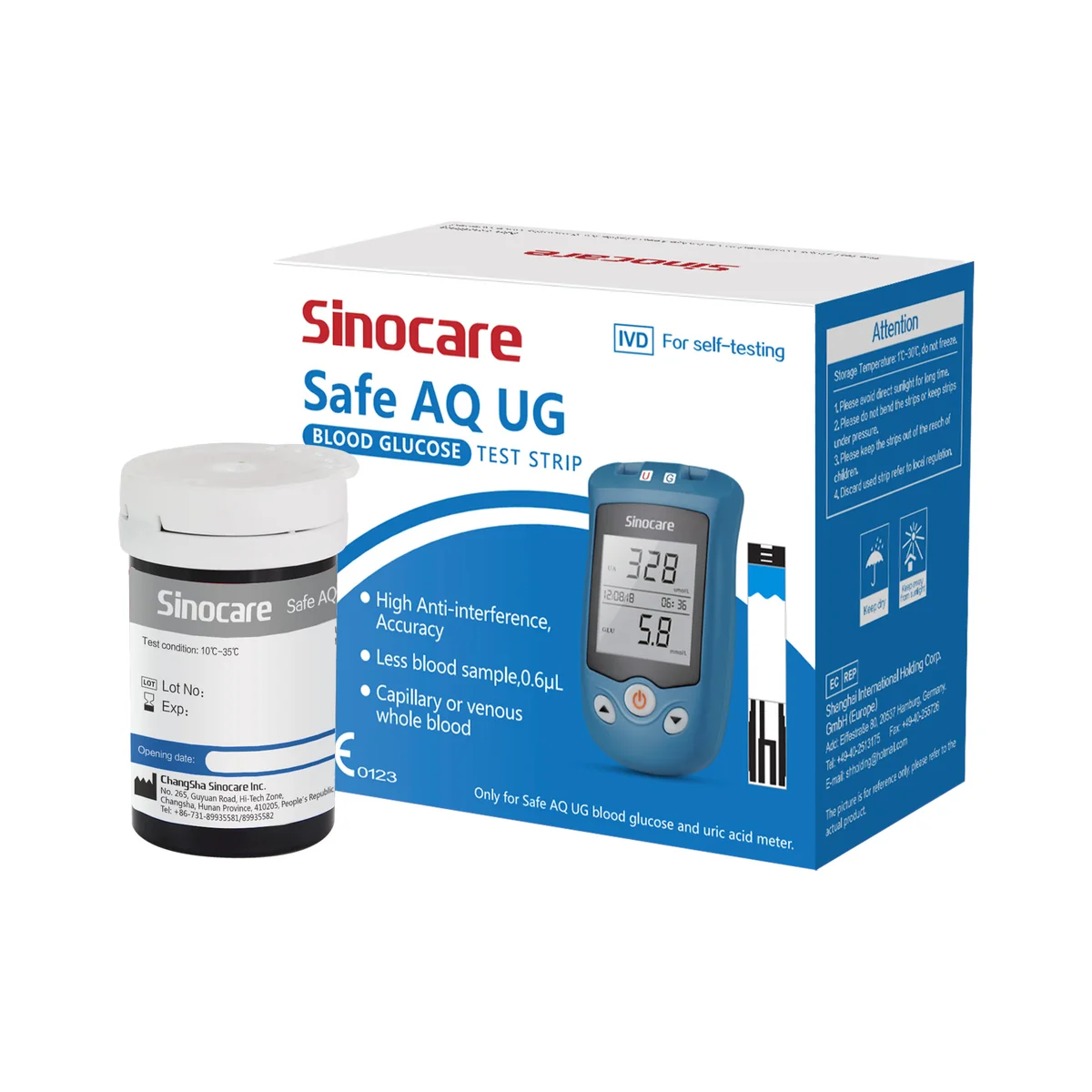
Ready to shop Sinocare? Use the link below to visit the official store.
→ Shop Sinocare — official site
Visit this site